 November 20, 2026
| By
admin
Inexpensive Car Battery vs. Cheap Battery: What’s the Real Difference?
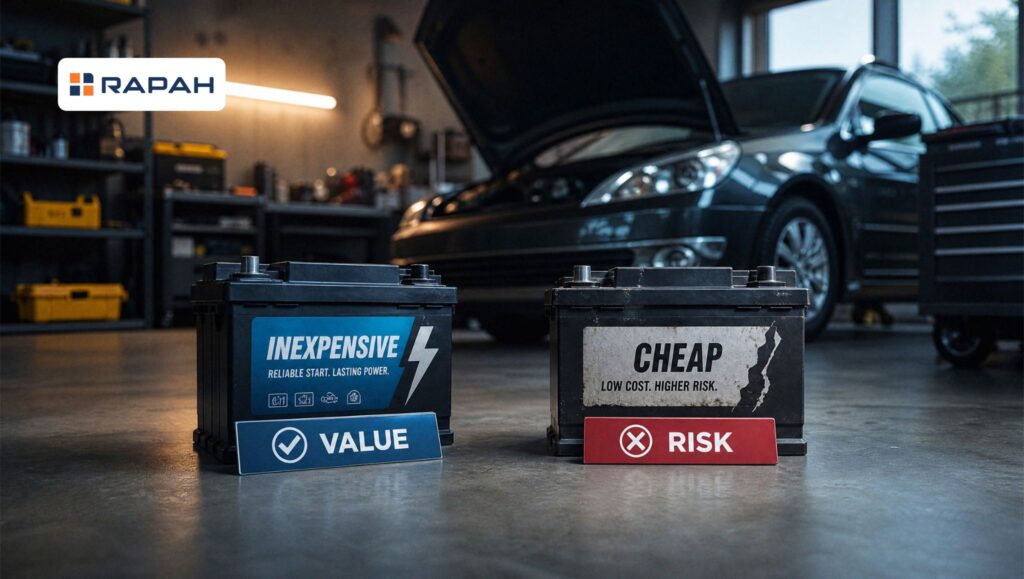
An inexpensive car battery can be a smart buy. A cheap one often costs more in the long run. Price isn’t the difference. Cold cranking amps (CCA), warranty, and battery type are. This guide shows you how to read a battery label, when a standard battery is enough, and when paying a little more saves money.
You turn the key on a busy morning, with school bags in the back, and the engine only clicks. Now you need a new battery, and the price range is wide. One costs half as much as the next. Surely they do the same job?
Sometimes they do. Often they don’t. In this guide, we will see what separates a good-value battery from one that’s just low-priced, so you can spend sensibly and avoid buying twice.
What’s The Difference Between An Inexpensive Car Battery And A Cheap One?
Inexpensive means a fair price for a battery that meets your car’s needs: the right size, enough power, and a solid warranty. Cheap means the price was the only thing the battery was built to win on, usually with a short warranty, thin specs, or an unknown brand.
A simple test: a good budget battery explains itself on the label and in the paperwork. A cheap one makes you guess.
Why Is Price Alone A Poor Guide?
A battery that costs less but lasts a year less isn’t saving you anything. Compare the cost per year of use, not just the sticker price. Divide the price by the warranty period as a rough starting point.
What Do CCA, Warranty, And Battery Type Actually Tell You?
These are the three things that separate the two categories.
CCA
CCA (cold cranking amps) measures how much current a 12V battery can deliver at -18°C (0°F) for 30 seconds while staying above a minimum voltage. Higher CCA means stronger starts in cold conditions. For most family cars, match the CCA your manufacturer recommends, found in the owner’s manual or on your current battery. Going far below it risks hard starts; going far above rarely helps.
Warranty
The warranty is the maker’s own estimate of confidence. A longer warranty usually signals better internal build. Check whether it’s a full replacement warranty or a pro-rated one, which gives you only partial credit later in the period.
Battery Type: AGM vs. Standard
Standard batteries are the budget workhorse. They suit many older and simpler vehicles.
AGM (Absorbent Glass Mat) batteries are sealed, handle deep discharging better, and cope with heavy electrical loads. Many cars with start-stop systems specify AGM, and fitting a standard battery there can shorten its life.
How Long Does A Budget Battery Last?
Most car batteries last roughly three to five years, depending on heat, driving habits, and electrical load. Hot climates and short trips wear batteries faster. A cheap battery with a short warranty tends to land at the lower end of that range, or below it.
How Do You Choose The Right Battery? A Quick Checklist
- Check your owner’s manual for the recommended size, CCA, and type.
- Look for start-stop. If your car has it, AGM is usually required.
- Compare warranty terms, not just length. Is it full replacement?
- Check the manufacture date. A battery that has sat on a shelf for a long time has already aged.
- Ask about fitting and disposal. Proper fitting protects your car’s electronics.
- Work out cost per year, not just the sticker price.
Exceptions worth knowing
- Older car, short local trips: a quality standard battery is often enough.
- Newer car with lots of electronics: don’t downgrade the type to save money.
- Rarely driven car: the battery’s charge matters more than a premium label.
Should You Fit The Battery Yourself?
It looks simple, but a swap can go wrong. Disconnecting in the wrong order, loose terminals or skipping the memory-saving step can trigger electrical faults, lost settings or, in newer cars, system errors that need resetting. Batteries also contain acid and are heavy, and old ones need safe disposal.
Get The Right Battery Without The Guesswork
Back at that morning click: the fix isn’t the lowest price on the shelf; it’s the right battery, correctly fitted. That means matching CCA and type to your car, choosing a warranty you can rely on, and letting someone do the job properly.
Here’s what to remember:
- Inexpensive means good value; cheap means price-first.
- CCA, warranty, and battery type tell you what the price doesn’t.
- Cost per year beats sticker price.
- Correct fitting protects both the battery and your car.
Ready to stop worrying about the next cold start? Tell Rapah your car model, and we’ll recommend and fit an inexpensive battery that suits it, with a clear warranty and no hidden extras.
FAQs
- Is a cheap car battery ever worth it?
Rarely. If it meets your car’s CCA and type requirements and carries a solid full-replacement warranty, it may be fine. If it doesn’t, you’ll likely replace it sooner.
- Does a higher CCA always mean a better battery?
No. Match your car’s recommended CCA. More than you need doesn’t improve everyday performance.
- Can I put a standard battery in a car that came with AGM?
It’s not recommended. Cars designed for AGM, especially with start-stop, can wear out a standard battery quickly.
- How do I know my battery is on its way out?
Slow cranking, dim lights at idle, a warning light, or a battery older than about four years are common signs. A quick test will confirm it.
- Does the warranty cover fitting?
Usually the warranty covers the battery itself, not the labour to fit it. If the battery fails because of a manufacturing fault, the maker replaces it. Whether fitting is covered depends on the seller: some include it, some charge for it, and some only cover the part.